
Taylor Release Dates Explained
A projected date is an estimate or a date produced from the sentence record. It is not proof that a person walked out of custody on that day. An actual release occurs only after staff clear the sentence, court orders, warrants, detainers, and any transfer instructions. Taylor County Jail records make this difference visible in a simple way: the public roster may show CURRENTLY BOOKED while a recent or date-range result may show RELEASED. The roster does not publish a projected-release field.
A person held before trial often has no fixed date. Bond may be posted, a judge may change conditions, a charge may be resolved, or another agency may lodge a hold. A sentenced person has a sentence end point, but parole action, lawful credit, discipline, a revised sentence, or a detainer can alter the path to that date.
Find a Taylor Projected Release
Start with the agency that has custody. The Taylor County roster is the right first check for a local jail booking. The GDC offender search is the right route after state-prison intake. A Taylor County booking and a GDC record are not interchangeable.
- Check the jail roster for a local booking and note the status, arrest date, court, charge, bond, and days in jail.
- If the person remains at Taylor County Jail, ask the jail or the court named on the booking record whether a release order or sentence end date exists.
- If the person entered state custody, search GDC by name, ID, case number, age, or identifying details and review the facility and release information.
- If parole may apply, use the Board's TPM tool for review timing. Do not read a TPM as a promise of release.
- Check all holds before treating a date as community release. A date may instead mark transfer to another authority.
The broader Taylor County released-inmate search path explains how the local roster, court record, and state record fit together after a person leaves custody.
Georgia Credits and Taylor Releases
Taylor County does not publish a local jail good-time formula in the researched sources. A caller should not subtract an assumed number of days from a county sentence. The jail and sentencing court must supply the controlling local date. For a state sentence, GDC and the Georgia State Board of Pardons and Paroles maintain separate dates and decisions.
GDC's Performance Incentive Credit program lets an eligible offender earn up to twelve points through a case plan, education or vocational improvement, and work assignments. Those points may reduce a Tentative Parole Month or Maximum Release Date by one to twelve months. The program excludes death sentences, sentences of two years or less, life sentences, and non-parole-eligible or minimum-mandatory sentences.
Georgia does not impose one blanket 85-percent rule on every prisoner. Serious violent felony and mandatory-minimum provisions, including O.C.G.A. 17-10-6.1, can control service and parole eligibility. The correct question is which law applies to the sentence, not which broad percentage is often repeated.
Why Taylor Release Dates Move
A date can move for reasons found in the sentence, prison record, or another agency's hold. The source of the change points to the office that can verify it.
| Factor | Possible effect | Confirm with |
|---|---|---|
| Bond or court order | Creates, changes, or cancels a local release path | Taylor County Jail and named court |
| PIC credit | May reduce a TPM or maximum date for an eligible GDC offender | GDC record and case staff |
| Misconduct | May postpone or cancel a TPM | Parole Board and GDC |
| Parole review | May set, defer, or deny a parole date | Georgia Parole Board |
| Detainer or warrant | May turn release into transfer rather than freedom | Holding and receiving agencies |
| Sentence change | Can revise the maximum or controlling date | Sentencing court and GDC |
Confirm a Taylor County Release
For a local case, call Taylor County Jail at 478-862-5444 and use the court shown in the booking record. Superior Court and its clerk hold durable felony disposition records. Magistrate Court handles warrants, certain misdemeanors, and bail matters, while Probate Court handles county traffic matters. The booking's court field prevents calls from being sent to the wrong office.
For a state case, compare the GDC release-date guidance, offender result, and parole record. GDC also directs written verification to Inmate Records and Information, PO Box 1529, Forsyth, GA 31029. Georgia VINE can provide a custody-change alert, but the alert is not a discharge order.
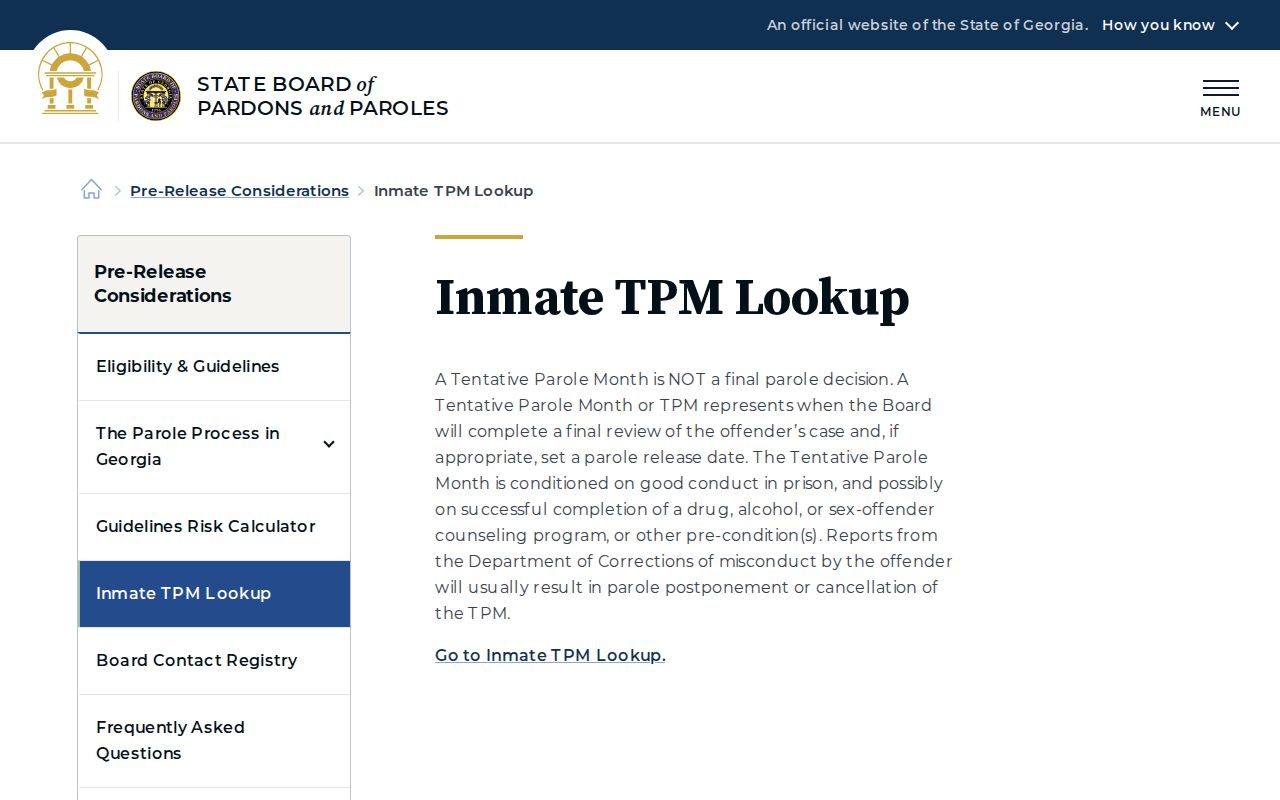
The Board's TPM page says the tentative month is when final review is due. If appropriate, the Board then sets a parole release date. Good conduct and required programming matter, and misconduct can postpone or cancel the tentative month.
The official TPM explanation is visible in the following successful research capture.
Taylor Dates by Custody System
A county jail date may turn on bond, time served, a local sentence, warrant clearance, a transfer order, or a detainer. GDC dates arise from a state sentence, maximum release date, parole eligibility, statutory limits, and authorized credits. Federal custody has its own record system. A result from one system should never be used to fill a gap in another.
- Maximum Release Date
- The calculated end of a state sentence, subject to lawful changes.
- Tentative Parole Month
- The month set for Board final review, not a promised exit date.
- Detainer
- A request or hold that may cause transfer to another authority after local custody ends.
- Discharge
- The end of a sentence or supervision obligation, distinct from a transfer.
Note: A Taylor County roster status of RELEASED confirms departure from that booking, but it does not by itself prove release to the community.
After a Taylor State Release
A state-prison release can include practical steps that are not part of Taylor County Jail procedure. GDC explains that remaining offender account funds may be placed on a Georgia Release Card. The released person activates the card and creates a PIN through the card process. This is a state-custody detail, not evidence that the local jail uses the same method.
The GDC release-card page is the source for activation help and current instructions. It also illustrates why confirming the custody system matters: a Taylor County sentence that led to GDC custody ends through state procedures, while a person leaving the county jail follows local release processing.
A date should also be read with the status attached to it. A future maximum date belongs to a person serving a sentence. A past date may mark release, discharge, or a move to supervision. If a Taylor County case produced probation rather than prison, the court disposition and Georgia Department of Community Supervision records matter more than a prison locator. If parole followed a GDC term, the Parole Board's released-person search and the Columbus DCS field office can confirm the supervision layer.
Keep copies of the result and note the date checked. Public systems update on different schedules, and a phone confirmation may be newer than a saved search result. When records conflict, ask the agency that owns the controlling sentence or hold to explain which date remains active.
Taylor Release Date Limits
Taylor County Jail does not publish a projected-release field. Its roster instead shows arrest date, days in jail, total bond, court, charge information, and present booking status. Those fields can suggest why timing is uncertain, but they cannot be combined into a reliable release formula. Bond may be posted, a judge may enter a new order, a warrant may clear, or another agency may lodge a hold. Only the jail and court can confirm how those events affect a local date.
Georgia prison calculations require a different review. PIC points apply only to eligible GDC offenders. The program excludes death-sentence cases, sentences of two years or less, non-parole-eligible or minimum-mandatory sentences, and life sentences. Eligible work, case-plan, education, or vocational progress can earn up to twelve points, with a possible one-to-twelve-month reduction to a TPM or Maximum Release Date. That range describes the program, not a promised credit for one person.
Georgia has no universal rule that every prisoner serves the same fixed percentage. Serious-violent and mandatory-minimum laws, including O.C.G.A. 17-10-6.1, can control eligibility. Read the sentence, statutory eligibility, GDC record, and Board result together before relying on any projected date.
Note: Recheck the controlling agency after any court order, misconduct report, detainer, or sentence change because each can alter the displayed date.